
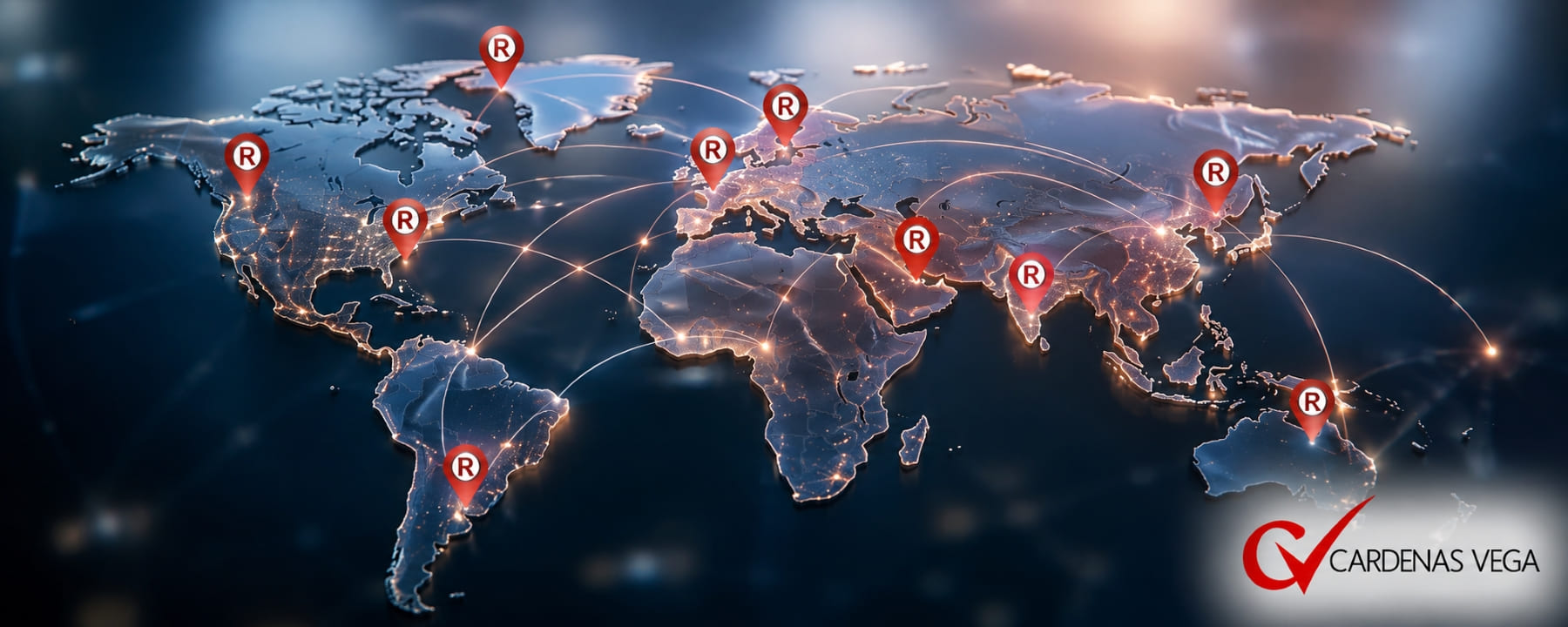
International trademark registration enables a trademark to be protected in the countries where a company markets, or intends to market, its goods or services. As a general rule, a trademark registered in Colombia produces effects only within Colombian territory. Accordingly, expanding a business into other markets requires an international protection strategy based on national or regional registrations or, where appropriate, the Madrid System for the International Registration of Marks.
There is no single registration that automatically protects a trademark in every country worldwide. Protection must be sought in the jurisdictions of interest, and each intellectual property office determines, in accordance with its own legislation, whether the trademark is entitled to protection.
Is a trademark registered in Colombia valid in other countries?
No. Trademark rights are, as a general rule, territorial in nature. Consequently, a trademark registered with the Colombian Superintendence of Industry and Commerce (Superintendencia de Industria y Comercio – SIC) is protected primarily within Colombian territory, and its registration does not automatically grant exclusive rights in other countries.
There is, however, a particular mechanism within the Andean Community. Decision 486 provides for what is commonly known as an Andean opposition, which may allow the owner of a registered trademark, or an earlier applicant, in one Member Country to oppose certain subsequent applications filed in another Member Country, provided that the requirements established by Andean legislation are met. These requirements include demonstrating a real interest in the market concerned and filing an application for registration of the trademark in that country at the time the opposition is submitted.
Accordingly, trademark protection in Colombia may produce certain legal effects under the Andean regime, but this does not mean that the trademark is automatically registered in Ecuador, Peru or Bolivia.
What is an international trademark?
The term international trademark is commonly used to refer to a trademark for which protection is sought in several countries through the Madrid System, administered by the World Intellectual Property Organization (WIPO).
The Madrid System makes it possible to file an international application and designate one or more of its members in which protection is sought. It currently comprises 117 members covering 133 countries, including major commercial markets such as the United States, China and the European Union.
However, an international registration does not constitute a universal authorization to use a trademark. Following international registration by WIPO, the intellectual property offices of the designated territories examine the trademark under their respective laws and may grant or refuse protection.
What is the Madrid System for the International Registration of Marks?
The Madrid System is an international mechanism administered by WIPO that facilitates the filing and management of trademarks in multiple jurisdictions through a centralized procedure.
Instead of filing separate applications from the outset with each selected national or regional office, the trademark owner may file an international application based on a trademark application or registration previously filed with the Office of origin and designate the Madrid System members in which protection is sought.
Its principal features include:
- The ability to file a single international application designating multiple countries or regions.
- Centralized management of certain matters relating to the international registration.
- Payment of fees through a system administered by WIPO.
- The ability to extend protection subsequently to additional members through subsequent designations.
- A centralized renewal date for the international registration.
The Madrid System simplifies certain administrative aspects, but does not replace national legislation. Each designated Office retains the authority to examine the application and determine whether the trademark satisfies the requirements for protection in its territory.
How can an international trademark application be filed from Colombia?
Colombia is a member of the Madrid Protocol. Accordingly, an individual or legal entity that meets the requirements of the Madrid System may use Colombia as the Office of origin to seek protection for its trademark in other members of the System.
In general terms, the procedure involves the following stages:
- Have a basic application or registration. The international application must be based on a trademark application or registration before the Office of origin.
- Identify the territories of interest. The applicant must select the Madrid System members in which protection is sought.
- File the international application through the Office of origin. The Office verifies certain matters relating to the correspondence between the international application and the basic application or registration.
- Formal examination by WIPO. The World Intellectual Property Organization reviews the application for compliance with the applicable formal requirements.
- International registration and notification. If the formal requirements are satisfied, the trademark is recorded in the International Register and the designated members are notified.
- Examination in each designated territory. The competent Office of each designated member examines the trademark under its own legislation and may grant protection or issue a provisional refusal.
A certificate of international registration issued by WIPO confirms completion of the relevant international phase, but does not necessarily mean that the trademark has been accepted for protection in every designated territory.
What happens if a foreign trademark office objects to the mark?
Each designated Office may issue a provisional refusal if it determines that the trademark does not comply with the requirements established under its legislation or where a third party files an opposition, as applicable.
In such cases, the trademark owner must respond to the proceeding in accordance with the applicable rules and within the relevant time limits in that jurisdiction. Depending on the jurisdiction and the nature of the objection, representation by local counsel or a local trademark agent may be required.
A refusal in one particular country does not, by itself, mean that the trademark will be refused in the other designated territories. Each designation is examined under the legal framework applicable in the territory concerned.
What is the dependency on the basic application or registration?
During the first five years from the date of the international registration, the international registration remains legally dependent on the basic application or registration on which it was based.
This means that if, during that period, the basic application or registration ceases to have effect, wholly or in part, as a result of certain circumstances contemplated under the Madrid System, the international registration may be affected to the same extent. This mechanism is traditionally associated with the concept known as a central attack.
This dependency is one of the factors that should be considered when determining whether the Madrid System or separate national or regional applications provide the more appropriate filing strategy.
Is it better to use the Madrid System or register the trademark directly in each country?
There is no single answer. The appropriate strategy depends on the countries in which protection is sought, the number of markets involved, the commercial importance of each territory, the legal position of the trademark, the likelihood of objections or oppositions, and the company's expansion plans.
The Madrid System may be particularly efficient where protection is sought in multiple member jurisdictions and the applicant wishes to centralize certain aspects of the international management of its trademark portfolio.
In other circumstances, it may be preferable to file separate national or regional applications, particularly where the strategy requires jurisdiction-specific attention from the outset, where particular legal circumstances exist, or where the territories of interest are not members of the Madrid System.
Accordingly, before filing an international application, it is advisable to determine which route offers the most appropriate legal and administrative structure for the particular trademark portfolio.
In which countries should I register my trademark?
As a general principle, a company should consider protecting its trademark in those countries where it currently markets, or genuinely intends to market, its goods or services.
The strategy may take into account, among other factors:
- Markets in which goods are currently sold or services are provided.
- Countries included in genuine commercial expansion plans.
- Territories in which goods are manufactured or distributed.
- Markets relevant to e-commerce or licensing activities.
- Countries in which there is a specific risk that a third party may appropriate or register the trademark.
Indiscriminately registering a trademark in numerous territories is not necessarily the best strategy. In addition to the associated costs, the laws of different countries may impose requirements or consequences relating to the genuine use of trademarks. International protection should therefore be based on a realistic and legally planned commercial strategy.
Trademark registration in the United States, Europe, China and other markets
Cárdenas Vega Asesores provides services relating to the international protection of trademarks and coordinates trademark proceedings in multiple jurisdictions, including countries in North America, Central America, South America, Europe and Asia.
Depending on the circumstances, the strategy may be structured through the Madrid System, separate national applications, regional registrations or a combination of these mechanisms.
Before filing an international application, it is also advisable to conduct trademark clearance searches in the relevant markets and carefully review the goods and services for which protection is sought, since registrability may vary from one jurisdiction to another.
Frequently asked questions about international trademarks
Is there a trademark registration that automatically provides worldwide protection?
No. Trademark protection remains territorial. The Madrid System makes it possible to centralize an international application and designate multiple territories, but each competent Office determines whether protection will be granted in its jurisdiction.
Do I need a registered trademark in Colombia to use the Madrid System?
There must be a basic application or registration before the relevant Office of origin. Accordingly, it is not always necessary to wait until the Colombian registration has been granted before commencing the international procedure, although relying on a pending application as the basis for the international registration involves legal considerations that should be assessed as part of the filing strategy.
Can an international trademark be refused in one country and granted protection in another?
Yes. Each designated member examines the trademark under its own legislation. A trademark may therefore obtain protection in certain territories while being objected to or refused in others.
Can I add new countries after the international registration?
Yes. The Madrid System allows the geographical scope of an international registration to be extended subsequently to additional members through subsequent designations, subject to the applicable requirements and fees.
Can Cárdenas Vega Asesores handle trademark registrations outside Colombia?
Yes. Cárdenas Vega Asesores provides international trademark protection services and can structure and coordinate registration strategies in multiple jurisdictions according to the client's markets of interest.